
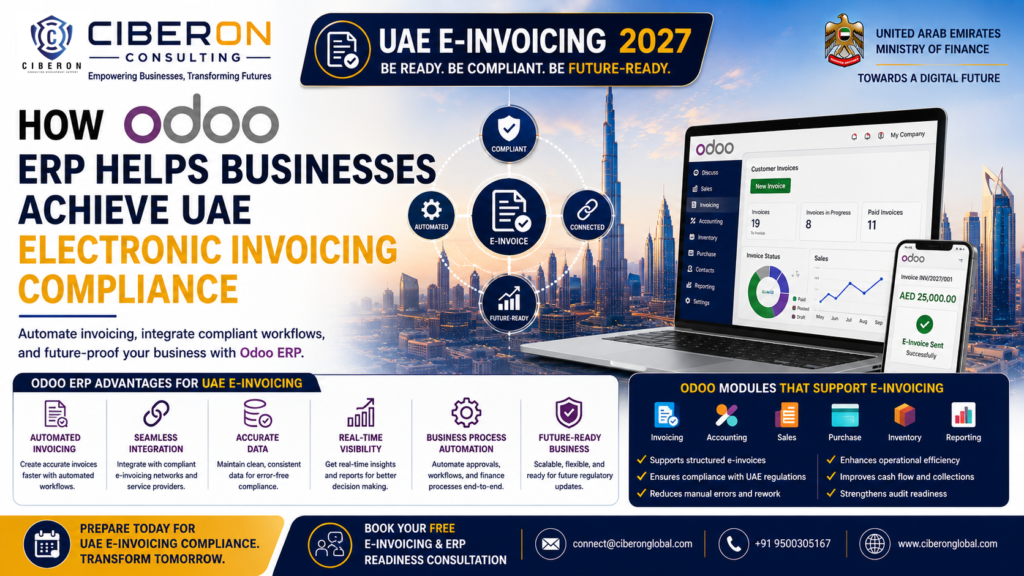
UAE Electronic Invoicing is changing the way businesses manage invoices, financial data, and digital transactions. For companies operating in Dubai, Abu Dhabi, Sharjah, and across the UAE, preparing for e-Invoicing is not simply about replacing PDF invoices. It requires businesses to evaluate their ERP systems, data, workflows, integrations, and overall digital infrastructure.
For CEOs, CFOs, business owners, finance managers, IT leaders, and ERP decision-makers, this transformation presents an important opportunity. The right ERP system and implementation strategy can help businesses automate financial processes, improve data accuracy, integrate business applications, and prepare for the UAE’s structured Electronic Invoicing framework.
One ERP platform receiving significant attention from growing businesses is Odoo ERP. With its integrated business applications for accounting, sales, purchasing, inventory, CRM, and other operations, Odoo can provide a strong foundation for businesses looking to modernize their financial and operational processes.
However, businesses should understand an important distinction: having Odoo ERP does not automatically mean that a company is compliant with the UAE Electronic Invoicing requirements. The UAE’s e-Invoicing framework has specific technical and regulatory requirements, and businesses must ensure that their complete solution, including the relevant Accredited Service Provider and integrations, meets those requirements.
This article explains how Odoo ERP can support the preparation and transformation journey while highlighting what UAE businesses should consider before implementation.
Understanding UAE Electronic Invoicing
The UAE Ministry of Finance defines an eInvoice as a structured form of invoice data that is issued and exchanged electronically between a supplier and buyer and reported electronically to the UAE Federal Tax Authority.
This is fundamentally different from sending a PDF invoice through email.
PDF files, Word documents, images, scanned invoices, and email attachments are not considered eInvoices under the UAE framework. The objective is to move businesses toward structured electronic data and a more digitally connected invoicing ecosystem. (Ministry of Finance)
The UAE Electronic Invoicing programme is being introduced in phases. The pilot phase began on 1 July 2026, while voluntary implementation is also possible from that date. Mandatory implementation is being phased according to revenue thresholds, with businesses generating annual revenue of AED 50 million or more scheduled for mandatory implementation from 1 January 2027 and businesses below AED 50 million scheduled from 1 July 2027. (Ministry of Finance)
For UAE businesses, this means the preparation process should begin well before the applicable implementation date.
Why ERP Matters for UAE e-Invoicing
Electronic Invoicing is closely connected to the way your business generates, processes, records, and manages financial transactions.
Consider a typical business transaction.
A customer places an order. The sales team records the transaction. Inventory may be updated. The finance team generates an invoice. Tax information is applied. The invoice is recorded in the accounting system. Payment information is tracked. Management may then use the transaction data for reporting and decision-making.
If these activities are managed across disconnected systems, spreadsheets, emails, and manual processes, e-Invoicing preparation can become more complicated.
An integrated ERP system can provide a central environment where business processes and financial data are connected.
This is where Odoo ERP implementation can become valuable for businesses seeking greater automation and operational visibility.
How Odoo ERP Supports Automated Invoicing
Odoo provides integrated accounting and invoicing functionality that can help businesses manage customer invoices, credit notes, vendor bills, payments, and financial information within an integrated ERP environment.
Odoo’s documentation also describes Electronic Data Interchange functionality that can automate the exchange of business documents, including invoices and credit notes, using structured formats and electronic networks such as Peppol where supported. (Odoo)
For a UAE business, this creates an important foundation.
Instead of relying heavily on manual invoice preparation, businesses can connect sales, accounting, inventory, purchasing, and other processes within one ERP environment.
The result can be a more consistent and automated financial workflow.
Odoo ERP and Business Process Automation
One of the biggest advantages of an ERP system is that it can help reduce repetitive manual activities.
Imagine a business where sales information is manually copied into an accounting system before an invoice is created.
This creates additional work and increases the possibility of data-entry errors.
With an integrated ERP environment, information can flow between connected business functions, reducing unnecessary duplication and improving process consistency.
For UAE companies preparing for Electronic Invoicing compliance, this can be particularly valuable because structured invoice data requires businesses to pay closer attention to the quality and consistency of the information used to generate invoices.
Business Process Automation can therefore become an important part of the wider e-Invoicing readiness strategy.
Better Data Quality for e-Invoicing
Data quality is one of the most important considerations when preparing for UAE Electronic Invoicing.
Your ERP may contain thousands of customer records, supplier records, products, services, tax information, addresses, payment terms, and transaction records.
If this information is incomplete, inconsistent, or outdated, it can create challenges when businesses transition to structured Electronic Invoicing.
Odoo can provide a centralized environment for managing business information across multiple functions.
However, implementing software alone does not solve data-quality problems.
Businesses should review their existing customer and supplier master data, tax information, product and service records, and invoice fields before starting their e-Invoicing implementation.
A professional ERP consulting partner can help identify data gaps and create a structured data-cleaning and migration strategy.
Odoo ERP Integration and UAE e-Invoicing
Another major consideration is integration.
UAE Electronic Invoicing is built around structured electronic transactions and an ecosystem involving Accredited Service Providers. The UAE framework is based on the international OpenPeppol standard. (Ministry of Finance)
Therefore, businesses should not think of e-Invoicing as an isolated feature inside an accounting system.
The wider technology environment matters.
Your ERP may need to interact with an Accredited Service Provider and other business systems depending on your organization’s requirements and implementation approach.
This makes ERP integration and system integration critical components of the implementation strategy.
Businesses using Odoo should therefore assess how their Odoo environment will connect with the required e-Invoicing ecosystem rather than assuming that installing an invoicing module alone will satisfy the UAE requirements.
Odoo ERP for Growing UAE Businesses
UAE businesses operate across a wide range of industries, including manufacturing, retail, trading, distribution, construction, professional services, education, healthcare, and technology.
Many growing organizations need an ERP platform that can scale with their operations.
Odoo provides an integrated suite of applications that can bring multiple business functions into one environment.
For a growing UAE company, this can help connect sales, CRM, accounting, inventory, purchasing, employees, projects, and other business activities.
When combined with a carefully planned UAE e-Invoicing readiness strategy, an Odoo ERP implementation can become part of a broader digital transformation programme.
The objective should not simply be to make invoices electronic.
The objective should be to create a more connected and automated business.
Odoo ERP and Financial Visibility
For CEOs and CFOs, one of the most important benefits of ERP is improved financial visibility.
When financial information is spread across spreadsheets, email conversations, standalone applications, and disconnected systems, management may not have a complete view of business performance.
An integrated ERP environment can help bring financial and operational information together.
This can support faster reporting, improved monitoring, better transaction visibility, and more informed decision-making.
As the UAE moves toward greater digitalization of business transactions, having reliable and accessible financial data can become increasingly important.
The UAE Ministry of Finance has identified digitalization, operational efficiency, transparency, and compliance among the objectives of the Electronic Invoicing programme. (Ministry of Finance)
Odoo ERP Is Not a Substitute for an Accredited Service Provider
This is an important point for UAE businesses.
Businesses should not assume that selecting Odoo automatically makes them compliant with UAE Electronic Invoicing.
The UAE framework involves Accredited Service Providers, and the Ministry of Finance maintains an official list of pre-approved providers. (Ministry of Finance)
Odoo’s own documentation confirms that its e-invoicing functionality varies by country and that country-specific capabilities should be evaluated. Its current documentation does not list the UAE among the country-specific e-invoicing localizations shown on its documentation page. (Odoo)
Therefore, UAE businesses considering Odoo should take a solution-level approach.
The organization should evaluate the Odoo version and configuration, required UAE functionality, integration requirements, the appropriate Accredited Service Provider, data requirements, testing requirements, and the overall compliance architecture.
This is where experienced Odoo ERP consulting becomes particularly important.
How CiberOn Consulting Can Help
At CiberOn Consulting, we help businesses evaluate their ERP environment and prepare for the transition toward UAE Electronic Invoicing.
Our approach begins with understanding your business rather than immediately recommending software.
We assess your current invoicing processes, ERP environment, accounting workflows, data quality, integration requirements, and automation opportunities.
For businesses using Odoo ERP, we can support Odoo ERP implementation, ERP customization, ERP integration, business process automation, data migration, workflow optimization, testing, employee training, and ongoing ERP support.
For businesses using other enterprise platforms, our ERP consulting expertise also covers SAP Business One and Microsoft Dynamics 365, allowing organizations to evaluate their wider ERP and digital transformation requirements.
Our goal is to help businesses build a practical roadmap that connects their technology strategy with their operational objectives.
The Odoo ERP Implementation Journey
A successful Odoo ERP implementation for UAE businesses should begin with business and technology assessment.
The next stage is understanding the organization’s invoicing processes, data structure, financial workflows, and integration requirements.
Once the requirements are understood, the ERP environment can be configured and customized according to the business’s operational needs.
Data preparation and migration can then be planned carefully to avoid carrying unnecessary or inaccurate information into the new system.
Integration requirements should be evaluated before testing begins.
Testing should cover business workflows, invoice generation, data, integrations, user activities, and relevant scenarios.
Employees should receive appropriate training before the system goes live.
After implementation, ongoing ERP support and optimization can help the organization adapt as business requirements and regulatory requirements evolve.
This structured approach can reduce implementation risks and improve user adoption.
Turn UAE e-Invoicing Into a Digital Transformation Opportunity
The biggest mistake businesses can make is treating UAE Electronic Invoicing as a simple invoice-format change.
It is much broader than that.
It is an opportunity to review how your organization manages financial data, business processes, ERP systems, integrations, automation, reporting, and digital operations.
For CEOs and business owners, the transition can become a catalyst for modernization.
For CFOs, it can support stronger financial processes and visibility.
For IT leaders, it can provide an opportunity to modernize system integration.
For finance teams, it can reduce repetitive manual activities.
For growing companies, it can create a stronger technology foundation for future expansion.
Is Your Odoo ERP Ready for UAE Electronic Invoicing?
If your business is already using Odoo ERP in the UAE, now is the right time to assess your current environment.
If you are considering implementing Odoo ERP, e-Invoicing readiness should be included in your ERP planning from the beginning.
If your business is still using spreadsheets, standalone accounting software, or legacy systems, the UAE Electronic Invoicing transition may also be an opportunity to consider a broader ERP implementation and digital transformation strategy.
The key is to start with assessment rather than assumptions.
Your business needs to understand its current technology environment, data readiness, integration requirements, and implementation options before making critical decisions.
Prepare Today for a More Connected UAE Business
UAE Electronic Invoicing represents an important step in the country’s broader digital transformation journey.
Businesses that prepare early can use the transition to improve their ERP systems, automate financial workflows, strengthen data quality, and create a more connected digital environment.
Odoo ERP can be an important part of that journey, but successful implementation requires more than software.
It requires the right ERP strategy, business process analysis, data preparation, integration approach, testing, training, and professional consulting support.
If your organization is evaluating Odoo ERP in the UAE, preparing for UAE e-Invoicing, or planning a broader ERP digital transformation, now is the right time to start.
Book Your Free UAE e-Invoicing & ERP Readiness Consultation
Let CiberOn Consulting assess your current ERP and invoicing environment and help you identify the next steps toward a more automated, integrated, and future-ready business.
Email: connect@ciberonglobal.com
Phone: +91 9500305167
Website: www.ciberonglobal.com
Note: UAE e-Invoicing requirements and technical specifications are evolving. Businesses should verify the latest requirements through the official UAE Ministry of Finance e-Invoicing portal before making compliance decisions. (Ministry of Finance)
[104165]supplies professional anti-violence equipments and solutions for the whole world with strong and perfect production capacity. anti-violence.org
how to play wild truck wild trucks bet