
The countdown to UAE Electronic Invoicing has begun. For businesses operating across Dubai, Abu Dhabi and the wider UAE, 2027 is not simply another compliance deadline. It represents a major shift in how businesses create, exchange, process and report invoice information.
For CEOs, CFOs, finance directors, business owners and technology decision-makers, the most important question is no longer whether UAE e-Invoicing is coming. The real question is whether your business has a clear roadmap to become ready.
The UAE Electronic Invoicing programme is designed around structured electronic invoice data that can be issued, exchanged and reported electronically. Traditional formats such as PDF files, Word documents, images, scanned invoices and invoices sent only as email attachments do not qualify as eInvoices under the UAE framework. The UAE Ministry of Finance has also adopted a Peppol-based model involving Accredited Service Providers to facilitate electronic invoice exchange and reporting.
This means that preparing for UAE e-Invoicing Compliance requires more than changing the format of an invoice. Businesses need to evaluate their ERP systems, data, workflows, integrations, technology infrastructure and internal processes.
Why Businesses Should Start Their UAE e-Invoicing Preparation Now
Waiting until 2027 to begin planning could create unnecessary pressure for your finance and technology teams.
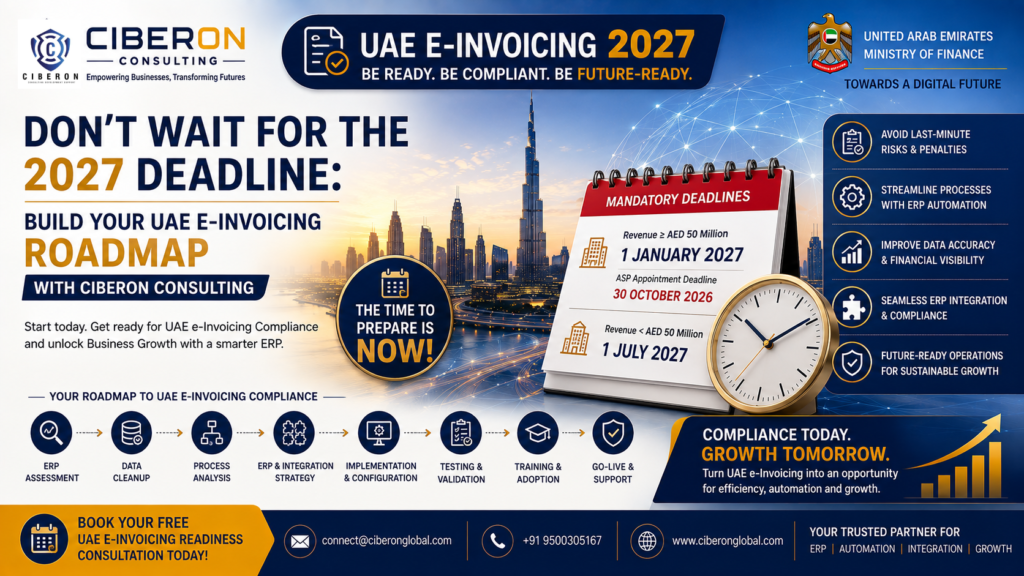
An e-Invoicing implementation can involve several stages, including assessing your existing ERP, reviewing business data, identifying process gaps, selecting the right technology approach, integrating systems, preparing employees, testing workflows and establishing ongoing support.
For businesses with annual revenue of AED 50 million or more, the mandatory implementation date is 1 January 2027, and the deadline to appoint an Accredited Service Provider has been extended to 30 October 2026. Businesses with annual revenue below AED 50 million have a mandatory implementation date of 1 July 2027.
The UAE Ministry of Finance has stated that the eInvoicing pilot programme began on 1 July 2026, allowing the programme to progress toward the mandatory implementation phases.
For businesses, this means the preparation window is already underway.
The earlier you assess your current environment, the more time you have to make informed decisions rather than rushing into an ERP or e-Invoicing solution simply because the deadline is approaching.
What Does UAE e-Invoicing Readiness Really Mean?
UAE e-Invoicing Readiness means understanding whether your current business environment can support the transition to structured electronic invoicing.
Your readiness does not depend only on the software you use.
It depends on how your business operates.
Your customer data needs to be accurate.
Your supplier information needs to be reliable.
Your tax information needs to be properly maintained.
Your invoice data needs to be structured.
Your ERP needs to support the required processes.
Your business applications may need to communicate with one another.
Your employees need to understand the new workflows.
Your finance and IT teams need to be aligned.
A proper readiness assessment brings all these elements together and provides management with a clear picture of what needs to happen next.
Step One: Assess Your Existing ERP
The first stage of your roadmap should be an ERP assessment.
Businesses across the UAE operate on different technology platforms. Some use modern ERP systems, while others continue to rely on legacy accounting software, spreadsheets or multiple disconnected applications.
Whether your organization uses Odoo ERP UAE, SAP Business One, Microsoft Dynamics 365 or another ERP platform, you should first understand how your existing system manages invoicing and financial data.
The assessment should examine your invoice generation process, customer and supplier data, tax configuration, accounting workflows, integrations and reporting capabilities.
The objective is not automatically to replace your ERP.
In many cases, the right solution may involve configuration, customization, integration or upgrading the existing system.
For organizations considering ERP Consulting UAE, this assessment can provide a clear starting point for the entire implementation journey.
Step Two: Evaluate Your Business Data
Data quality is one of the most important parts of UAE e-Invoicing preparation.
Many businesses have accumulated years of customer, supplier, product and financial information across different systems.
Duplicate records, outdated customer details, inconsistent product descriptions, incomplete tax information and manually maintained spreadsheets can make implementation more complicated.
Before connecting your ERP to an e-Invoicing environment, your business should understand the quality of its existing data.
A data-readiness review can identify information that needs to be cleaned, standardized, migrated or reorganized.
This is especially important for organizations planning ERP Integration UAE, because information may need to move between multiple business applications.
Step Three: Map Your Current Invoice Process
Before implementing new technology, understand how your business currently creates an invoice.
Where does the transaction begin?
Does it start with a quotation, sales order, purchase order or another business process?
Where is customer information stored?
How is tax calculated?
Which system generates the invoice?
How does the invoice reach the customer?
How is the accounting entry created?
How is payment tracked?
How are corrections and credit notes handled?
Answering these questions helps reveal manual processes and technology gaps.
It can also identify opportunities for Business Automation UAE.
Instead of simply digitizing your existing process, you can redesign inefficient workflows and create a more streamlined operating environment.
Step Four: Build the Right ERP Integration Strategy
The UAE e-Invoicing framework uses Accredited Service Providers and a Peppol-based interoperability model. The Ministry of Finance describes a framework in which invoice data moves between businesses through Accredited Service Providers, with reporting to the relevant government platform.
This makes ERP Integration UAE an important component of your roadmap.
Your ERP may need to interact with CRM systems, inventory platforms, e-commerce applications, accounting tools, payment systems and other business software.
A successful integration strategy should determine where invoice information originates, how it is transformed or validated, where it is transmitted and how information is received back into your business systems.
This is why selecting the right ERP Consulting UAE partner can be as important as selecting the software itself.
Step Five: Consider Odoo ERP for a More Connected Business
For SMEs and growing companies, Odoo ERP UAE can provide an opportunity to bring multiple business functions into a connected ERP environment.
Odoo can support business functions such as accounting, sales, CRM, purchasing and inventory, depending on the modules and configuration selected for the organization.
However, implementing Odoo is not simply a matter of installing software.
A successful Odoo ERP Implementation UAE project should begin with an understanding of your business processes, data structure, integration requirements and long-term objectives.
The objective should be to create an ERP environment that supports the organization’s operations while preparing it for evolving digital requirements.
For businesses operating in Dubai, Odoo ERP Dubai and Odoo Consulting Dubai can form part of a wider ERP modernization strategy.
Step Six: Decide Whether Your Business Needs ERP Transformation
Not every organization will require a complete ERP replacement.
Some businesses may already have a capable system that requires configuration or integration.
Others may have outgrown their existing accounting software and require a more comprehensive ERP platform.
Some organizations may need to connect several legacy applications.
The right decision depends on your current technology environment, business processes, transaction volumes, growth plans and future requirements.
This is where UAE ERP Solutions should be evaluated strategically.
A good ERP solution should not only address today’s invoicing needs. It should also support future business growth, reporting, automation and integration.
For businesses in Dubai, ERP Consulting Dubai and ERP Implementation Dubai can help organizations evaluate their technology options and develop a structured implementation roadmap.
Step Seven: Prepare for System Testing
Technology implementation should never move directly from configuration to live operations without proper testing.
Your business should test invoice workflows, customer data, tax information, integrations and exception scenarios.
Finance teams should be involved in validating financial information.
IT teams should verify system connectivity and data flow.
Business users should test the processes they will use every day.
Testing provides an opportunity to identify problems before they affect real transactions.
It also gives your employees confidence in the new system.
Step Eight: Train Your Finance and Business Teams
A successful UAE e-Invoicing implementation depends on people as much as technology.
Finance employees need to understand new invoice workflows.
Sales teams need to understand how transaction data affects invoicing.
IT teams need to understand integrations and system dependencies.
Management needs visibility into the new financial processes and reporting.
Training should therefore be included in your implementation roadmap from the beginning.
At CiberOn Consulting, training and knowledge transfer can form part of the wider ERP implementation and support process, helping businesses move from technology implementation toward practical adoption.
Step Nine: Turn Compliance Into Business Automation
UAE e-Invoicing should not be viewed only as a compliance exercise.
It can also become an opportunity to improve operational efficiency.
When your ERP, finance systems and business applications are connected, repetitive manual processes can be reduced.
Customer information can flow more efficiently.
Invoice generation can become more structured.
Financial information can become easier to access.
Management reporting can become more consistent.
This creates an opportunity to combine UAE e-Invoicing Compliance with Business Automation UAE.
Instead of investing only in compliance, businesses can use the transition to improve how their entire organization operates.
Step Ten: Use e-Invoicing as Part of Digital Transformation
The UAE is continuing its transition toward a more digitally connected economy, and the Ministry of Finance has identified digitalization, efficiency, transparency and compliance among the objectives of the eInvoicing programme.
For businesses, this creates an opportunity to look beyond invoices.
Your e-Invoicing project can become part of a broader Digital Transformation UAE strategy.
You can evaluate your ERP.
You can improve your data.
You can connect your systems.
You can automate financial processes.
You can strengthen reporting.
You can prepare your organization for future digital requirements.
This is where UAE Finance Automation becomes particularly valuable.
A more connected finance function can provide management with better visibility while reducing unnecessary manual effort.
Why CiberOn Consulting?
At CiberOn Consulting, we help businesses approach UAE e-Invoicing as a structured ERP and digital transformation project.
Our role is not limited to software implementation.
We help businesses understand their current technology environment, identify potential gaps and develop a practical roadmap aligned with their operational requirements.
Our expertise includes ERP Consulting UAE, Odoo ERP Implementation UAE, ERP Integration UAE, Business Process Automation, ERP Customization, Data Migration, System Integration, Digital Transformation, ERP Support and Maintenance.
For organizations evaluating Odoo, we provide support around Odoo ERP UAE, Odoo ERP Implementation UAE, Odoo ERP Dubai and Odoo Consulting Dubai.
For organizations evaluating broader ERP options, we can support technology assessment, implementation planning and integration strategies around UAE ERP Solutions, ERP Solutions UAE, ERP Consulting Dubai and ERP Implementation Dubai.
The goal is simple.
We want to help businesses move from uncertainty to a clear roadmap.
Your Roadmap Should Start With an Assessment
There is no single e-Invoicing strategy that works for every business.
A manufacturing company may have completely different requirements from a retail business.
A construction company may have different workflows from a professional services organization.
A growing SME may have different technology needs from a large enterprise.
That is why the first step should be assessment.
Understand your current ERP.
Understand your data.
Understand your processes.
Understand your integrations.
Understand your business objectives.
Then create the roadmap.
Don’t Let the Deadline Decide Your Strategy
The biggest mistake a business can make is waiting until the final months before beginning its preparation.
A rushed implementation can create unnecessary technology costs, employee pressure, integration challenges and operational disruption.
Starting early gives your organization time to evaluate options.
It gives your finance and IT teams time to prepare.
It gives management time to make informed technology decisions.
Most importantly, it gives your business the opportunity to turn a compliance requirement into a business improvement initiative.
Build Your UAE e-Invoicing Roadmap With CiberOn Consulting
The future of invoicing in the UAE is structured, connected and digital.
The businesses that prepare early will have more time to assess their technology, improve their data, modernize their processes and build a scalable ERP environment.
Don’t wait for the 2027 deadline to start planning.
Start by understanding where your business stands today.
Then build a roadmap for where you need to be tomorrow.
CiberOn Consulting can help you move from ERP assessment to UAE e-Invoicing readiness, system integration, business automation and compliance-ready operations.
Book Your Free UAE e-Invoicing Readiness Consultation
Are you a CEO, CFO, business owner or decision-maker preparing your organization for UAE e-Invoicing?
Let CiberOn Consulting assess your current ERP and business processes and help you identify the next steps.
Contact CiberOn Consulting today.
Email: connect@ciberonglobal.com
Phone: +91 9500305167
Website: www.ciberonglobal.com
Your compliance deadline is approaching. Your roadmap should start now.
#UAEElectronicInvoicing #UAEeInvoicing #UAEeInvoicingCompliance #UAEeInvoicingReadiness #UAEeInvoicing2027 #OdooERPUAE #OdooERPImplementationUAE #ERPConsultingUAE #ERPIntegrationUAE #UAEERPSolutions #OdooERPDubai #OdooConsultingDubai #ERPConsultingDubai #ERPImplementationDubai #ERPSolutionsUAE #BusinessAutomationUAE #DigitalTransformationUAE #UAEFinanceAutomation #DubaiBusiness #AbuDhabiBusiness #UAEBusiness #CiberOnConsulting